One Story That Turned a Pitch Into a Standing Ovation
Silver Bullets
It’s my second week at Slack, where I’m a senior product marketing manager.
On a team call, I’m told they want me to solve their “Microsoft problem.”
Earlier this summer, Microsoft released its own subpar version of Slack, the business communication and collaboration platform, but it’s free and they are distributing it to every Office 365 user — all 345 million of them.
It’s like opening the freezer and finding free ice cream. Even if it’s not good ice cream, it’s there, so you eat it.
I’m terrified. How can I compete with free ice cream?
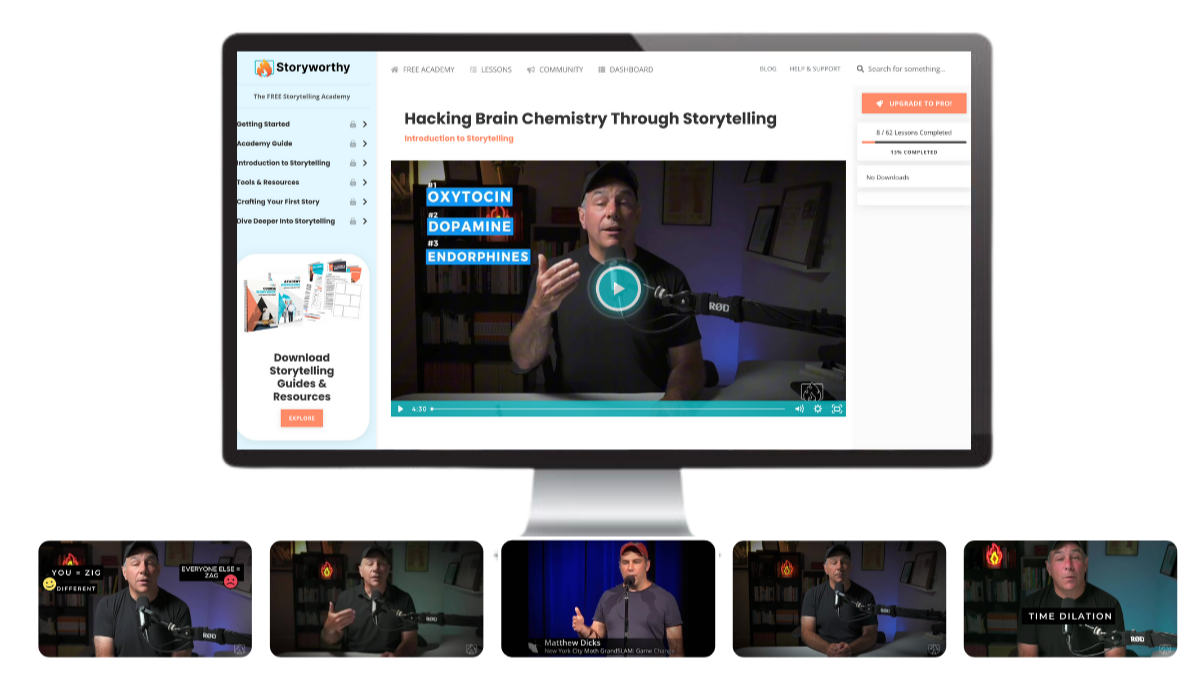
Luckily, when I got the job, I picked up Storyworthy by Matthew Dicks.
I knew I’d need all of the ammo I could find to do something different on Slack’s competitive team.
I tell the team with fake confidence not to worry: “The best story always Wins.”
Then I get off the call and freak out. They need me to make silver bullets from scratch. I decide reading Storyworthy isn’t enough. I need Matthew Dicks himself to teach me everything he knows.
It’s the day after my birthday, I email Matt one run-on sentence sprinkled with the words Slack, enterprise, and corporate, hoping it has enough corporate hair-flipping to warrant a response.
I find out later Matt has never heard of Slack, but he does have a philosophy of always saying yes, which his wife, Elysha, reminds him of when he mentions a random woman from the internet has cold-emailed him asking for help building corporate narratives and delivering them to sales teams.
Matt’s yes changes the course of my career at Slack and later my life.
I go all-in with Matt. I have to. Nothing else can win against Microsoft except the best story, and I’ve been calming everyone’s fears across the company like a tent-pole evangelist with that one line.
Two things feel radical during our first remote meeting.
First, I’m startled by how present Matt is. He isn’t diverting his eyes, checking messages on the side, or answering emails while I’m talking, like I’m used to with my coworkers. It’s like we are in the room together. He understands the urgency of the request and is working with me by offering up ideas, phrasing, and concepts, though he’s never even seen the product I’m working on.
Second, in the middle of our session, I realize that I’m learning. And not by observation, like listening to a VP talking in a meeting. Matt is teaching me with the care and patience of a teacher invested in me learning a skill for life.
It’s profound to have this level of attention and not have to fight for it. As I put pen to paper with Matt crafting a new story for Slack and myself, it’s like learning how to build a Bentley from scratch with a master craftsperson, starting from molding clay. I talk about my paddleboarding stories, former World War II sites in Sausalito, and something I scribbled at 9 p.m. on a Tuesday while drinking wine during the pandemic. It all goes into the narrative we’re building. I add humor, vulnerability, stakes, suspense — everything Matt teaches me.
“Are you sure I can tell all of these personal stories in this narrative?” I ask nervously. Matt tells me it’s the only thing people will remember.
Four months later, I still don’t know how to put vacation hours into Workday, and my 401K is not set up, but I’m sitting in front of four hundred sellers, ready to jump off the diving board and deliver this narrative.
This is my silver bullet.
People cannot believe what they hear.
They have come expecting a standard sales enablement meeting, someone shrugging through a slide deck with barely a pulse.
What they get is high-velocity, bottled-up-then-shaken, cork-popped-open storytelling. Word gets out as our meeting is going on. Zoom crashes, unable to hold more than four hundred sellers. People beg for the recording.
Two years later, Slack continues to use that same sales narrative.
I become known as a storyteller.
Someone who will go there.
Someone who will zig when everyone else is zagging.
I continue learning everything I can from Matt — down to the details of how I finish a presentation. We practice me finishing like a gold medal gymnast landing perfect tens on the mat, hands outstretched. Instead of rolling off into the oblivion of another forgettable Zoom meeting, I try to stick the landing every time. Every detail matters in storytelling.
I write out my lines until I memorize them, and I keep writing them until I begin to feel something Matt possesses effortlessly when he tells stories — confidence.
I don’t tell anyone my big corporate secret. I write a “What Is Slack?” webinar constructed around stories of an evening surf session and a Taco Bell dinner. A few months later, the webinar is already garnering two hundred thousand dollars in sales.
Up to this point, learning the craft of storytelling from Matt is the only thing that has felt meaningful in my career. And it’s given me a meteoric rise professionally. It leads to radical opportunities — writing Slack’s first product narrative, writing Dreamforce keynotes, and creating Slack’s first corporate marketing division.
Before they give me my own team, they ask me what my secret is. Storytelling coaching, I say.
The moment I have a team, I send them all straight to Matt to begin their religious studies. Six months later, one of my direct reports is presenting at a Salesforce sales kickoff while sharing the stage with Marc Benioff, in front of all seventy thousand employees. Moments before she goes on, I watch her mouthing her talk, eyes closed, listening to her AirPods just like Matt taught her.
My cozy village disappears when Slack is acquired by Salesforce, and a small army of nonbelievers enter and become my peers. They don’t believe in storytelling. They believe in structure, slides, and formulas.
I’m devastated: How are there so many nonbelievers in storytelling?
I tell Matt there are days I sit on Zoom meetings and feel a strong gravitational pull to be bland, forgettable.
To not start with a story.
To not be funny.
To not show vulnerability.
“Keep going,” Matt says, coaching me. “Keep telling your stories.”
One day, they really need it.
Nobody can figure out how to tell the story of why Slack makes sense with Salesforce.
Their first draft falls flat. They ask me to write something new in forty-eight hours. I craft a narrative with surprise, stakes, and a sprinkle of vulnerability. I build a universe around these two products and show how that universe is so valuable for customers. I know it needs one more thing — a perfect transition, which has been my Achilles’ heel. Matt and I have been working on this for two years.
At 3 p.m. on a Thursday — the worst time slot, when everyone is brain dead — I get in front of the senior leaders of Slack and Salesforce, and I leave everything on the dance floor. I’m out of breath when I finish staring at the green laser beam on my computer’s camera.
Silence follows.
I can hear people’s eyes blinking. They were expecting me to sell them on a horse-drawn carriage — an old way of presenting, old ideas, a boring formula. But it’s a Bentley. Handcrafted elegance, craftsmanship, and attention to detail.
It’s bulletproof.
They can’t disassemble it.
They can’t pick it apart.
Nor do they want to.
They realize the performance they’ve just experienced.
The narrative makes it to Dreamforce, Silicon Valley’s biggest event of the year, storytelling bells and whistles and all.
At that moment, I know I’m ready for something new.
I’ve been on a two-year journey with Matt, not only studying storytelling but getting ready to start my own consulting business.
We’ve been formulating my own product narrative framework — how SaaS companies can tell the narrative of their products, just like I had written for Slack.
After starting my company, I land clients in industries from biotech to supply chain, and Matt comes along. We do the same thing for other companies that we once did at Slack and Salesforce. But now we go even bigger. We take out the biggest brushes and tell these companies’ stories with the broadest strokes.